The Ultimate Story Bible Guide: Templates, Examples & AI Tools (2026)
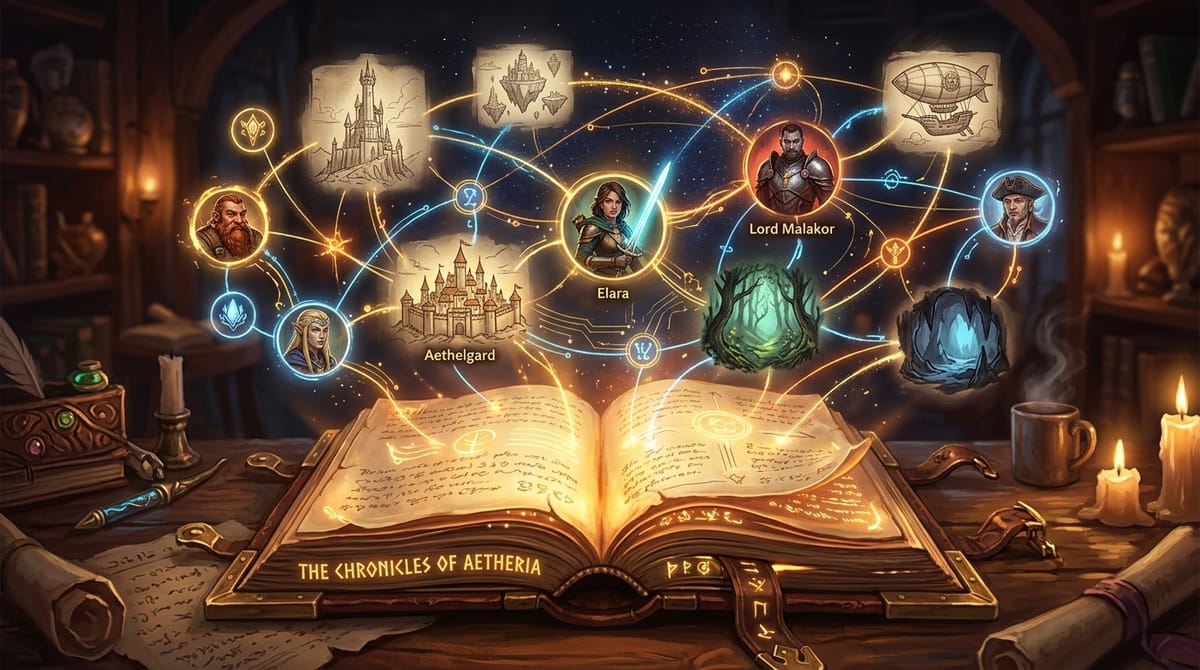
Every published novelist has a system for keeping track of their story's details. Some use spreadsheets. Some use notebooks. Some use the ancient method of "hoping they remember."
That system — formalized — is a story bible. And if you're writing anything longer than a short story, you need one.
This guide covers everything: what a story bible is, why it matters, what goes in one, free templates to get started, and how modern AI tools are transforming the story bible from a static reference document into a dynamic creative engine.
What Is a Story Bible?
A story bible (also called a series bible, novel bible, or story guide) is a comprehensive reference document that contains every important detail about your fictional world.
Think of it as the Wikipedia for your novel — except you're the only editor, and everything in it is canon.
A story bible typically includes:
- Character profiles (appearance, personality, backstory, relationships, arcs)
- Setting descriptions (locations, geography, atmosphere, sensory details)
- World rules (magic systems, technology, political structures, social norms)
- Timeline (chronological events, character ages at key moments)
- Style notes (tone, POV, tense, prose preferences)
- Plot structure (major beats, subplots, foreshadowing threads)
Why Every Novelist Needs a Story Bible
1. Consistency Across Your Manuscript
Was your protagonist's eyes blue in chapter 3 and green in chapter 17? Did the magic system work differently in the climax than it did in the setup? Readers notice these things — and reviewers definitely notice them.
A story bible prevents continuity errors by giving you a single place to check facts about your own world.
2. Faster Writing Sessions
When you sit down to write, you shouldn't spend 20 minutes re-reading previous chapters to remember what a character looks like. A quick glance at your story bible puts you right back in the world.
3. Essential for Series Writers
If you're writing a book series, a story bible isn't optional — it's survival. Characters evolve across books. Subplots carry forward. Readers who've memorized every detail of Book 1 will catch every inconsistency in Book 3.
A shared story bible across your series is the only reliable way to maintain continuity at scale.
4. Better Collaboration
Working with an editor, beta readers, or a co-author? A story bible gets everyone on the same page (literally) about your world's rules and your characters' details.
5. AI-Powered Writing That Actually Works
Here's where story bibles have become transformative in 2026: AI writing tools.
The biggest complaint about AI writing assistance is the "goldfish memory" problem — AI generates generic output because it doesn't remember your characters, your world, or your style from one prompt to the next.
A story bible solves this. When AI tools can access your complete story bible during generation, the output reflects your specific characters, your world's rules, and your prose style. The difference between AI with and without a story bible is like the difference between a stranger writing your book and a close collaborator who's read every draft.
What Goes in a Story Bible: Section by Section
Characters
For each major character, include:
The Basics:
- Full name (and any aliases/nicknames)
- Age, birthday, physical appearance
- Occupation, social status
- Key personality traits (3–5 dominant traits)
Going Deeper:
- Motivation (what do they want?)
- Fear (what do they avoid?)
- Wound (what happened in their past that shaped them?)
- Arc (how will they change by the end?)
- Speech patterns (formal? Sarcastic? Uses specific slang?)
- Relationships with other characters
Example:
Elara Voss — 32, former military cartographer turned reluctant revolutionary. Tall, angular features, keeps her dark hair cut short for practicality. Speaks in clipped, precise sentences — military habit she can't break. Distrusts authority but craves structure. Her wound: she mapped the supply routes that led to the Ashfield Massacre. Her arc: learning that precision isn't the same as control.
Settings & Locations
For each important location:
- Physical description (layout, architecture, atmosphere)
- Sensory details (sounds, smells, textures, light)
- Emotional tone (is this a safe place? A threatening one?)
- Who lives/works here
- Historical significance to the story
World Rules
This is especially critical for fantasy, sci-fi, and speculative fiction:
- Magic/technology systems: What can it do? What are the limits? What's the cost?
- Political structures: Who's in charge? What are the factions?
- Social norms: What's considered taboo? What's celebrated?
- History: Key events that shaped the current world state
- Economics: How does money/trade work?
The key principle: every rule must have a limitation. Unlimited power creates boring stories.
Timeline
A chronological list of events, both:
- Backstory events (things that happened before page 1)
- Story events (your plot beats in order)
Include dates or relative time references ("3 years before the story begins," "Day 12 of the journey").
Style Guide
Your story bible should include notes about how you're writing, not just what you're writing:
- Point of view (first person? Third limited? Omniscient?)
- Tense (past or present?)
- Prose style (sparse and Hemingway-esque? Lush and lyrical?)
- Dialogue conventions (do you use contractions? How do you handle accents?)
- Chapter structure (length? Do they end on cliffhangers?)
Story Bible Templates
Here are starter frameworks you can adapt:
Minimal Template (Short Stories / Novellas)
CHARACTER: [Name]
- Appearance:
- Personality (3 words):
- Wants:
- Fears:
- Speech pattern:

SETTING: [Location]
- Looks like:
- Feels like:
- Sounds like:

PLOT: [One-sentence premise]
- Opening:
- Midpoint turn:
- Climax:
- Resolution:
Standard Novel Template
Expand the minimal template to include:
- 5+ character profiles with relationships mapped
- 3+ detailed settings
- World rules section
- Full chapter-by-chapter outline
- Timeline of events
- Style guide
Series Template
Everything in the standard template, plus:
- Cross-book continuity tracker (what details carry forward)
- Character progression notes (where does each character end Book 1? Begin Book 2?)
- Unresolved threads (subplots, mysteries, foreshadowing that pays off later)
- Reader knowledge tracker (what does the reader know vs. not know at each point)
Static vs. Dynamic Story Bibles
Traditional story bibles are static documents — a Word doc, a Notion page, a physical notebook. You write them, then reference them manually while writing.
The problem: static story bibles go stale. You introduce a new character in chapter 12, forget to add them to the bible, and then can't find their eye color in chapter 20. You change a plot point during revision but don't update the timeline.
Dynamic story bibles — powered by AI — solve this problem by integrating directly into your writing process:
- Your story bible automatically feeds into AI operations, so every generated scene is consistent with your established world
- Characters, settings, and rules are linked and cross-referenced
- AI can flag when new writing contradicts existing story bible entries
- The bible evolves as your manuscript evolves
Tools like ProseWeave pioneered this approach with their AI-integrated Story Bible — where characters, settings, themes, and style guide are injected into every AI operation throughout your manuscript. The result: AI that doesn't just know your story exists, but understands it deeply enough to maintain consistency from chapter one to "The End."
Building Your Story Bible: A Practical Process
Don't try to build your entire story bible before writing a word. That's procrastination disguised as preparation. Instead:
Before Drafting
- Create profiles for your 3–5 main characters
- Describe your 2–3 primary settings
- Define any world rules that affect the plot
- Write a one-page plot summary
During Drafting
- Add new characters as they appear
- Update settings as you develop them
- Note any world rules you establish on the fly
- Track timeline events as they happen
During Revision
- Audit the entire bible for inconsistencies
- Fill in gaps you skipped during drafting
- Use consistency checking tools to find contradictions
- Finalize the bible as your "canon reference"
The Story Bible Advantage
Writers who maintain story bibles write faster, produce more consistent manuscripts, and revise more efficiently. In the age of AI-assisted writing, a thorough story bible is the difference between AI that helps and AI that hurts.
Your story bible is your novel's memory. Build it well, and everything else — the drafting, the revising, the AI assistance — gets dramatically easier.
Ready to build a Story Bible that actually powers your writing? ProseWeave's Guided Buildout walks you from a rough idea to a complete, AI-integrated Story Bible in minutes. Try it free for 30 days.