Story Structure for Novels: The Frameworks That Actually Help You Finish Your Book
Most aspiring novelists never finish their first draft. The right story structure changes that. Here's a clear, practical guide to the frameworks that work — and how to choose one.
Somewhere around chapter six, the wheels come off.
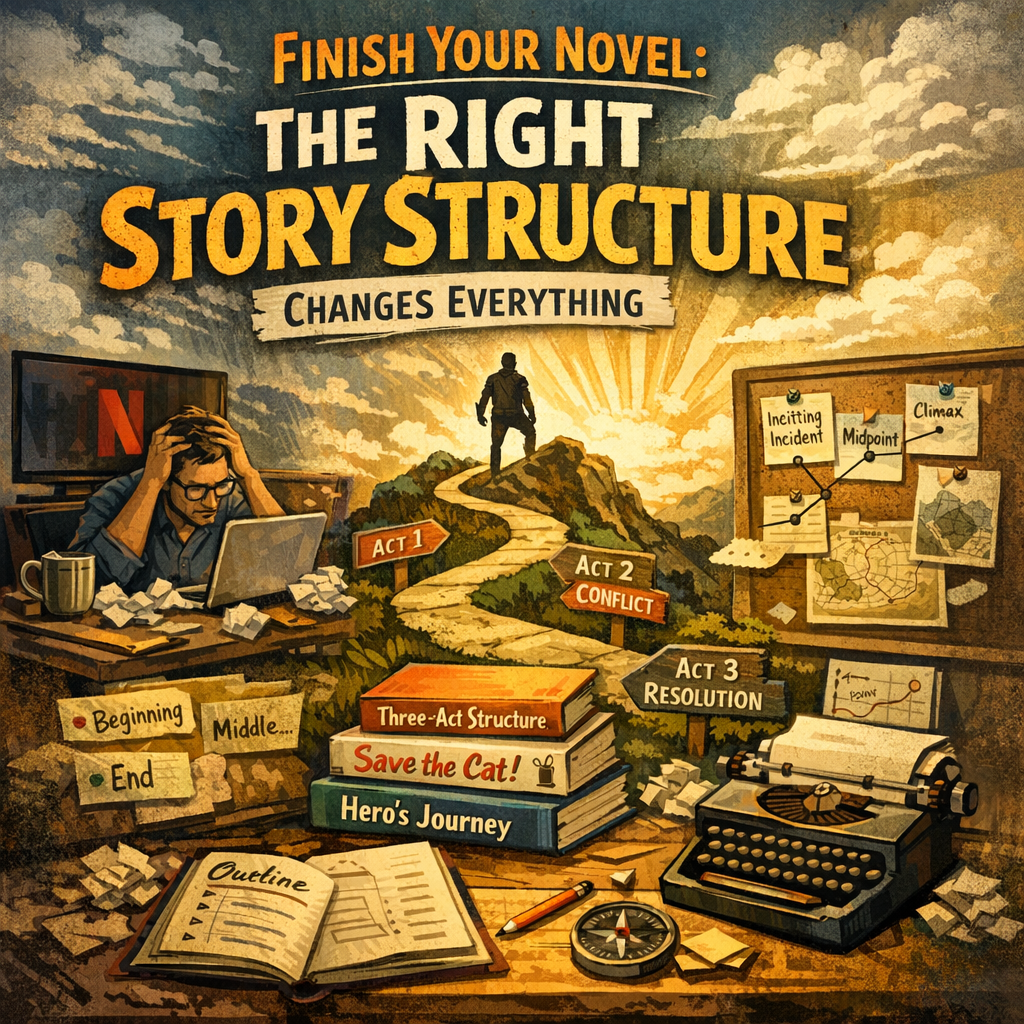
You started with momentum. The opening scenes wrote themselves. The characters felt alive, the premise was sharp, and for a few glorious weeks, you believed this was the one — the novel you'd actually finish. Then the middle arrived. Suddenly the plot that seemed so clear in your head turned into a fog. Characters wandered without purpose. Subplots multiplied like rabbits. And one evening, instead of opening the manuscript, you opened Netflix. Then you did it again the next night. And the night after that.
If this sounds familiar, you're in vast company. The commonly cited figure is that 97% of people who start writing a novel never finish it. That number is hard to verify precisely, but every writing teacher, literary agent, and published author will tell you the pattern is real. Novels die in the middle far more often than they die at the beginning.
The reason isn't talent. It isn't discipline, at least not primarily. The reason most novels collapse is structural. Writers run out of story because they never had a structure to run on.
This post is about fixing that — not with rigid formulas that strip the joy out of creative work, but with practical frameworks that give your story a skeleton strong enough to support whatever you want to build on top of it.
What Story Structure Actually Is (and What It Isn't)
Before we get into specific frameworks, it's worth clearing up a misconception that keeps many writers from engaging with structure at all.
Story structure is not a formula. It's not a paint-by-numbers template that tells you what happens on page 47. It's a set of principles about how narratives create and release tension — principles that have been observed across thousands of years of storytelling, from Greek tragedy to modern television.
When someone tells you a story needs a beginning, middle, and end, they're describing structure at its most basic. When a reader says a book "dragged in the middle" or "the ending felt rushed," they're identifying structural problems, even if they don't use that language.
Structure is what gives a reader the feeling that a story is going somewhere. Without it, even beautiful prose reads like a series of disconnected scenes. With it, even a simple story can feel propulsive and inevitable.
The goal isn't to restrict your creativity. It's to channel it. Think of structure less like a cage and more like the banks of a river — without them, water doesn't flow anywhere. It just spreads into a swamp.
The Three-Act Structure: Where Most Writers Should Start
If you've never worked with a formal story structure before, the three-act model is the clearest entry point. It divides your novel into three sections — Setup, Confrontation, and Resolution — with specific turning points that bridge them.
Act One (roughly the first 25% of your novel) introduces your protagonist, their world, and the status quo. Something then disrupts that status quo — the inciting incident — and by the end of Act One, your character makes a decision or faces a situation that locks them into the central conflict. This is the point of no return.
Act Two (the middle 50%) is where most novels live or die. Your protagonist pursues their goal, encounters escalating obstacles, and is forced to adapt. A midpoint event — often a revelation or reversal — shifts the nature of the conflict and raises the stakes. The second half of Act Two pushes the character toward their lowest moment, the point where everything seems lost.
Act Three (the final 25%) delivers the climax and resolution. The protagonist confronts the central conflict directly, drawing on everything they've learned and endured. The story resolves — not necessarily happily, but completely.
The elegance of this framework is its simplicity. You don't need to memorize fifteen beats or twelve stages. You need to answer four questions: What's the normal world? What disrupts it? What's the worst it gets? How does it resolve? If you can answer those, you have a structure.
Save the Cat: When You Need More Granular Guidance
Blake Snyder's Save the Cat Beat Sheet was originally designed for screenwriters, but it has become one of the most widely used frameworks in fiction writing. Where the three-act structure gives you broad landmarks, Save the Cat gives you fifteen specific beats — moments that should occur at roughly predictable points in your narrative.
The framework gets its name from an early principle: your protagonist needs a moment early in the story that makes the audience care about them. They "save the cat" — they do something that earns goodwill before the conflict even begins.
What makes Save the Cat particularly useful for beginning novelists is its attention to pacing. Each beat has a suggested placement (for example, the "Midpoint" occurs around the 50% mark, the "All Is Lost" moment around 75%), which prevents the most common structural failure: a second act that wanders without direction.
The framework also forces you to identify your story's theme early and thread it through every major beat. For writers who tend to discover their theme late in the drafting process — often too late to weave it in organically — this front-loaded approach can save significant revision time.
The trade-off is rigidity. Some writers find fifteen prescribed beats constraining, particularly for literary fiction or experimental narratives. If that's you, treat the beat sheet as a diagnostic tool rather than a blueprint. Write your draft, then map it against the beats to identify where your pacing falters.
The Hero's Journey: Structure Through Character Transformation
Joseph Campbell identified the Hero's Journey by studying myths across cultures and noticing the same pattern repeating: an ordinary person leaves their familiar world, faces trials in an unfamiliar one, and returns transformed. Christopher Vogler later adapted Campbell's framework into a practical twelve-stage model that writers actually use.
The Hero's Journey differs from the three-act structure and Save the Cat in one fundamental way: it's organized around character transformation rather than plot mechanics. The external events matter, but they exist to catalyze internal change. Each stage of the journey corresponds to a psychological threshold the protagonist must cross.
This makes the Hero's Journey particularly powerful for fantasy, adventure, coming-of-age, and any genre where the protagonist's inner growth is central to the story's meaning. It's less suited to ensemble narratives, mysteries driven by external puzzles, or stories where the protagonist deliberately resists change.
For aspiring novelists, the Hero's Journey offers a useful lens even if you don't follow it literally. Asking "what does my character need to learn?" and "what trial forces them to learn it?" produces stronger narrative decisions than asking "what happens next?"
The Seven-Point Structure: Focusing on Highs and Lows
The Seven-Point Structure strips narrative down to its emotional skeleton: seven moments that define the arc of tension in your story. Those moments are the Hook (where the character starts), Plot Turn 1 (the call to action), Pinch Point 1 (first major pressure), Midpoint (the shift from reaction to action), Pinch Point 2 (the darkest moment), Plot Turn 2 (the final piece of the puzzle), and the Resolution.
What distinguishes this framework is its emphasis on contrast. The Hook and the Resolution should mirror each other — showing who the character was and who they became. The Pinch Points exist specifically to apply pressure, ensuring the story never coasts.
Many writers find the Seven-Point Structure useful as a second-pass tool. Write your first draft using whatever method feels natural, then evaluate it against these seven points. If your story sags, you'll usually find that one or more of these moments is missing, misplaced, or underpowered.
How to Choose the Right Framework for Your Novel
With multiple frameworks available, the temptation is to study all of them before writing a single word. Resist that temptation. Analysis paralysis is a structure problem of its own.
Here's a practical decision framework.
If you've never outlined a novel before, start with the three-act structure. Its simplicity makes it easy to internalize, and it provides enough guidance to get you through a first draft without overwhelming you with beats and stages.
If you've tried writing a novel and stalled in the middle, try Save the Cat. Its granular beat sheet is specifically designed to prevent the "saggy middle" problem that kills most first drafts. The prescribed pacing gives you a roadmap through the section where most writers get lost.
If your story is driven by a character's internal transformation, lean toward the Hero's Journey. Its focus on psychological thresholds will help you build a plot that serves the character arc rather than competing with it.
If you prefer to write intuitively and revise structurally, the Seven-Point Structure makes an excellent diagnostic tool. Draft freely, then check your story against the seven points to find where the tension drops.
And here's the part that no framework article usually tells you: you can combine them. The three-act structure provides the broadest container. Save the Cat's beats can fill in the detail within those acts. The Hero's Journey can inform your character's emotional progression. These frameworks aren't competing religions — they're different lenses on the same underlying principles.
The Practical Step Most Writers Skip
Understanding structure intellectually is the easy part. The hard part is applying it before you write, when the outline feels lifeless compared to the vivid scenes playing in your imagination.
This is where many aspiring novelists make a critical mistake. They study structure, nod along, then open a blank document and start writing chapter one from the gut. The structure knowledge sits unused because the gap between theory and application feels too wide to bridge in the moment.
The solution is unsexy but effective: outline at the scene level. Take whichever framework resonates with you and identify the major structural beats. Then, for each beat, write a one-sentence description of the scene that delivers it. Don't write prose. Don't write dialogue. Just capture the function of each scene — what it needs to accomplish in the story's architecture.
This exercise typically takes two to three hours for a full novel outline. Those hours will save you weeks — possibly months — of revision later. When you know what each scene needs to do before you write it, you can focus your creative energy on how to do it well rather than figuring out what should happen next.
Structure Is Freedom, Not Constraint
There's a romantic notion in writing culture that real art comes from pure inspiration — that planning is the enemy of creativity, that outlines kill spontaneity, that the best stories are the ones that surprise even their authors.
There's a kernel of truth in that. Discovery and surprise are essential to vital fiction. But here's what the romantics don't mention: the writers who produce consistently are almost universally planners. They may not use the same framework. They may outline loosely or in obsessive detail. But they know where the story is going before they write the first word.
Structure doesn't prevent surprise. It creates the conditions for meaningful surprise. When you know the shape of your story, you can make bolder creative choices within it — because you know which walls are load-bearing and which ones you can knock out.
The 97% of novelists who never finish aren't failing because they lack talent or discipline. They're failing because they're trying to solve an engineering problem through sheer willpower. A novel is a complex narrative machine with hundreds of moving parts. No amount of passion can substitute for a blueprint.
Pick a framework. Outline your beats. Then write — with the confidence that comes from knowing your story has a destination.
Your novel deserves a spine. Give it one, and it will stand.