World-Building for Beginners: How to Create a Fictional World That Feels Real Without Losing Your Story
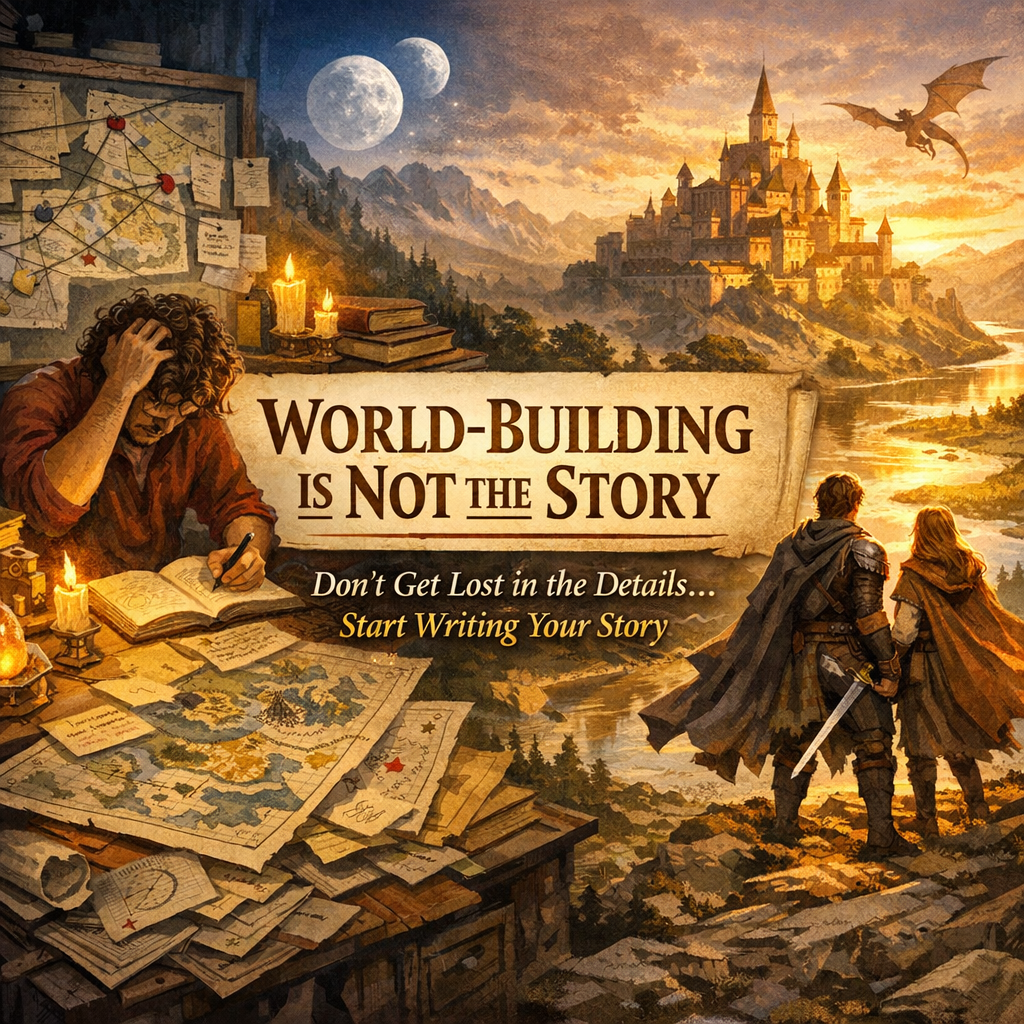
You've invented a continent. It has three kingdoms, a river system, two moons, a magic system with fourteen rules, a trade economy based on luminescent crystals, and a religion that fractured into four sects during a civil war two hundred years before your story begins.
You've been working on it for six months. You haven't written a single chapter.
If that sounds like an exaggeration, spend five minutes in any fantasy or science fiction writing forum. You'll find writers with binders full of maps, timelines, and language guides who haven't started their manuscript. You'll find others who dove into drafting without a plan and are now drowning in contradictions that make their world feel like a patchwork of ideas that don't quite hold together.
World-building is one of the most seductive parts of writing fiction — and one of the most dangerous. Done well, it creates the invisible architecture that makes readers feel like they've stepped into a living, breathing place. Done poorly, or done endlessly, it either suffocates the story or replaces it entirely.
This guide is for writers who want to build worlds that matter — worlds that serve the story, deepen the characters, and immerse the reader — without falling into the traps that stall most beginners.
World-Building Is Not the Story
This is the single most important principle, and it's the one most beginners resist.
Your world is the stage. It is not the play. No matter how intricate your magic system, how detailed your political map, or how original your alien biology, none of it matters if it doesn't serve the narrative. Readers don't show up for your world. They show up for your characters moving through your world, making decisions that the world's specific pressures force them to make.
The test is simple: if you removed a world-building element, would the plot or character development change? If the answer is no, the element is decoration. Decoration has its place — atmospheric detail can do real work — but it should never be mistaken for structure.
The writers who build the most memorable fictional worlds aren't the ones who build the most detailed worlds. They're the ones who build worlds where every detail pushes the story forward.
Start with What Your Story Needs, Not What Excites You
Beginning writers tend to world-build from the outside in. They start with geography, move to history, then politics, then culture, and eventually — sometimes months later — they try to figure out what story lives inside all of it.
The more effective approach is the opposite. Start with your protagonist. What do they want? What stands in their way? What forces — social, physical, supernatural, political — create the specific pressure that makes their journey difficult and meaningful?
Build outward from those questions. If your character is a healer in a society that criminalizes unauthorized magic, you need to build the legal system, the enforcement mechanisms, and the cultural attitudes toward magic. You don't need to build the continent's full geological history. Not yet. Maybe not ever.
This principle — build what the story demands — is what separates functional world-building from recreational world-building. Both can be enjoyable. Only one produces a finished novel.
Go Narrow and Deep, Not Wide and Shallow
Here's a pattern that trips up nearly every beginner: they try to build everything at once. Magic, politics, religion, ecology, economics, technology, social hierarchy, language — all at the same surface level. The result is a world that feels a mile wide and an inch deep. Every element exists, but none of them feel real.
The better approach is to choose two or three world-building domains and develop them thoroughly. If your story hinges on a rigid caste system, build that caste system with real depth — how it affects daily life, how people navigate it, where it cracks. If magic is central to your plot, define its rules, its costs, and its cultural implications with precision.
The domains you choose should be the ones that directly intersect with your protagonist's conflict. Everything else can remain sketched — present enough to feel like a complete world, but not so developed that it competes with the elements that actually drive the story.
Readers are remarkably good at filling in blanks. Give them a few vivid, specific details in the areas that matter, and their imaginations will furnish the rest.
Define Rules Before You Need Them
The fastest way to break a reader's immersion is inconsistency. If your magic system works one way in chapter three and a different way in chapter twelve, you've lost them — not because they're keeping score, but because the world stops feeling reliable. And an unreliable world is one readers can't invest in.
This applies to everything: magic systems, political structures, technology, social norms, even the physical laws of your world. The rules don't need to be complex. They need to be consistent.
For magic systems specifically, the key question isn't "what can magic do?" It's "what can't magic do, and what does it cost?" Limitations create stakes. A character who can do anything with magic faces no real tension. A character who must sacrifice something meaningful every time they use it faces a genuine dilemma — and genuine dilemmas are the engine of compelling fiction.
Write your rules down before you start drafting. Keep them in a reference document you can check as you write. This sounds tedious, but it's far less tedious than rewriting three chapters because your magic contradicted itself and you didn't catch it until a beta reader pointed it out.
Show the World Through Characters, Not Exposition
The second most common world-building mistake — after building too much — is revealing too much at once. Writers who've invested months in their world naturally want to show it off. The result is the info dump: paragraphs of lore, history, or explanation dropped into the narrative like a textbook excerpt.
Readers don't absorb information that way. They absorb it through experience — specifically, through the experience of characters they care about.
Instead of explaining that the kingdom's water supply is controlled by a corrupt guild, show your protagonist paying a bribe at the well. Instead of describing the magic system's rules in a prologue, let the reader discover them as the character learns to use — or struggle against — the system.
This technique is often called "iceberg world-building." The writer knows ninety percent of the world. The reader sees ten percent — the part that breaks the surface through action, dialogue, and sensory detail. The other ninety percent is felt rather than stated. It gives the world weight and texture without slowing the story down.
The discipline is harder than it sounds. You'll write paragraphs of beautiful exposition and have to cut them. That's normal. That's good. The exposition did its job — it helped you understand your world. The reader doesn't need it because you've already translated that understanding into scenes that feel grounded and specific.
Build Culture, Not Just Geography
Beginning world-builders gravitate toward the tangible: maps, climate, terrain, architecture. These elements matter, but they're not what makes a world feel inhabited. Culture does.
Culture is how people in your world greet each other, what they consider rude, what they eat for celebration, what they whisper about, what they're ashamed of, how they mourn. It's the unspoken rules that govern social interaction — the ones your characters follow without thinking about them, the same way you follow the unspoken rules of your own culture without thinking about them.
You don't need to design an entire anthropological profile. You need enough cultural specificity that your characters feel like products of their world rather than modern people in costume. When a character's values, assumptions, and reflexive behaviors are shaped by the world they grew up in, the world stops being a backdrop and starts being a character in its own right.
The shortcut: pick three cultural details that differ meaningfully from the reader's world and let those details ripple through your characters' behavior. Three is enough to establish that this world operates by its own logic. More than that risks overwhelming the reader; fewer risks a world that feels generic.
The Infrastructure Test
Here's a question that catches most beginners off guard: how does your world eat?
It sounds mundane, but it's the kind of question that separates worlds that feel real from worlds that feel like video game levels. If your story features a sprawling capital city, someone has to be growing food, transporting it, selling it, and disposing of the waste. If your characters travel for weeks through wilderness, they need supplies, and those supplies need to come from somewhere.
You don't need to write about agriculture. But you need to have thought about it, because the answers cascade into everything else — trade routes, class structures, political power, seasonal rhythms, what people value and what they take for granted.
This is the infrastructure test: can your world sustain itself? Could people actually live there, with the resources available, under the conditions you've described? If the answer is no — if your city has no water source, your army has no supply chain, your economy has no labor — the world will feel hollow even if the reader can't articulate why.
Think about logistics for thirty minutes. You'll be surprised how many story ideas emerge from the answers.
When to Stop Building and Start Writing
This is the question every world-builder dreads, because the honest answer is uncomfortable: you should start writing long before your world feels finished.
A world will never feel finished. There will always be another layer to develop, another system to refine, another cultural detail to flesh out. That's not a sign that the world isn't ready — it's a sign that world-building is an infinitely expandable task, and without a hard boundary, it will consume all available time.
The hard boundary is your story. Once you know your protagonist, their central conflict, and the two or three world-building domains that directly shape that conflict, you have enough to start drafting. Everything else can be built as needed — discovered in the writing, added in revision, refined as you understand more about what the story actually requires.
The writers who finish novels are not the ones with the most complete worlds. They're the ones who gave themselves permission to build a functional world and then started telling a story inside it.
Your world doesn't need to be perfect. It needs to be consistent, specific in the places that matter, and subordinate to the story it exists to serve.
Build the stage. Then raise the curtain.