Your Complete Camp NaNoWriMo 2026 Prep Guide (With AI)
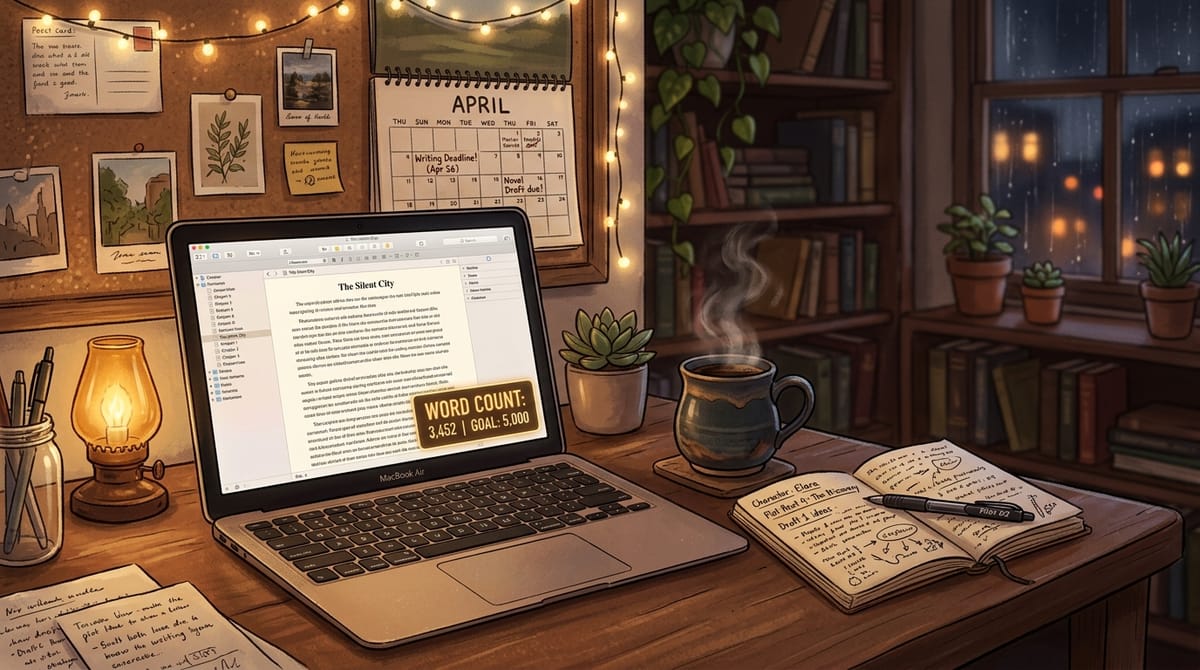
Camp NaNoWriMo is back — and April 2026 is just around the corner. Whether you're drafting your first novel, revising an existing manuscript, or tackling a passion project, Camp NaNo offers the perfect structure to get it done.
But here's the thing: this year, you don't have to do it alone. AI writing tools have matured to the point where they can genuinely accelerate your creative process — without replacing your voice.
This guide will walk you through preparing for Camp NaNoWriMo 2026 with AI as your co-pilot, from setting goals to building your story foundation to hitting your daily word counts.
What Is Camp NaNoWriMo?
Camp NaNoWriMo is a flexible writing event that runs every April and July. Unlike the main November challenge (50,000 words or bust), Camp lets you set your own goals — word count, page count, hours spent editing, or any measurable writing target.
It's ideal for:
- First-time novelists testing the waters with a smaller goal
- Series writers drafting the next installment
- Revision warriors who need accountability to finish edits
- Planners who want to build out their outline or story bible before drafting
Step 1: Set a Realistic Goal (Week of March 25–31)
The most common Camp NaNo mistake? Setting an unrealistic goal and burning out by day five.
Here's a framework based on your experience level:
| Experience | Suggested Daily Target | Monthly Total |
|---|---|---|
| First novel | 500–800 words/day | 15,000–24,000 |
| Experienced writer | 1,000–1,500 words/day | 30,000–45,000 |
| Speed drafter | 2,000+ words/day | 60,000+ |
| Revision focus | 1–2 hours/day | 30–60 hours |
Pro tip: If you're using AI to help with drafting, you can likely aim 30-40% higher than your usual target. AI helps you push through the moments where you'd normally stall — describing a setting, writing transition scenes, or generating dialogue variations.
Step 2: Build Your Story Bible Before April 1
This is where most writers either set themselves up for success or doom themselves to inconsistency. A story bible is your single source of truth — characters, settings, rules, relationships, and style — that keeps everything coherent across 30 days of fast drafting.
Before Camp NaNo starts, you should have:
Characters
- Full profiles for your 3–5 main characters (appearance, personality, motivation, speech patterns, arc)
- Brief notes on recurring secondary characters
- Key relationships mapped out
World & Settings
- Your primary settings described (sensory details, atmosphere, significance)
- Any rules of your world (magic systems, technology, social structures)
- A rough map or layout if relevant
Plot Foundation
- A beginning, middle, and end — even if it's loose
- Key turning points or setpiece scenes you're excited about
- The central conflict and stakes
Style Guide
- Your target tone (dark and literary? Light and witty? Tense and fast-paced?)
- POV and tense decisions
- Any specific voice notes ("short sentences in action scenes," "flowery prose for romantic moments")
Why this matters for AI-assisted writing: When your story bible is thorough, AI tools can generate output that actually sounds like your book — not generic fantasy prose or boilerplate dialogue. The more context AI has about your characters, world, and style, the more useful its suggestions become.
Tools like ProseWeave let you build a Story Bible that automatically feeds into every AI operation — so when AI helps you draft a scene, it already knows your character's speech patterns, your world's rules, and your preferred style.
Step 3: Outline Your First Week (March 28–31)
Don't try to outline the entire novel. Instead, plan your first 7 days in detail:
- Day 1–2: Opening scene and inciting incident
- Day 3–4: Character introductions and world establishment
- Day 5–7: First complication or twist
For each planned scene, write a 2–3 sentence beat:
Maya discovers the letter in her grandmother's attic. She doesn't recognize the handwriting, but she recognizes the address — it's the house she's been dreaming about for months. She decides to go there, despite her mother's warnings.
These beats become your daily writing prompts. When you sit down each morning, you know exactly what scene to write — no staring at a blank page.
Step 4: Set Up Your AI Writing Workflow
Here's a practical daily workflow for Camp NaNo with AI:
Morning (10 minutes): Review and Prep
- Read your beat for today's scene
- Review relevant story bible entries (which characters appear? what setting?)
- Jot down 2–3 key moments you want to hit in the scene
Writing Session (45–90 minutes): Draft With AI
- Start writing yourself — get 200-300 words down to establish your voice for the scene
- Use AI for momentum — when you hit a wall, have AI continue from where you stopped
- AI for descriptions — struggling with setting descriptions? Let AI draft one using your story bible, then edit to match your voice
- Dialogue generation — AI can draft dialogue variations that you then pick and polish
Evening (10 minutes): Clean Up
- Light editing pass on today's output
- Update your story bible with any new details (new character introduced? New location mentioned?)
- Write tomorrow's beat if you haven't already
Step 5: Common Camp NaNo Pitfalls (And How AI Helps)
"I don't know what happens next."
→ Use AI brainstorming to generate 5 possible directions for your next scene. Pick the one that excites you most.
"This scene is boring but necessary."
→ AI can help you find the conflict or tension in any scene. Feed it the setup and ask: "What's the most interesting thing that could go wrong here?"
"My characters all sound the same."
→ This is where a story bible shines. When AI knows that Character A speaks in short, clipped sentences while Character B is verbose and academic, the dialogue it generates will reflect those differences.
"I fell behind and can't catch up."
→ AI-assisted writing makes catch-up days realistic. A focused 2-hour session with AI support can easily produce 2,000–3,000 words that still sound like you.
"My plot has a hole I didn't notice."
→ Consistency checking tools can scan your manuscript for contradictions, timeline errors, and character inconsistencies — catching problems before they compound.
Step 6: Track Your Progress
Camp NaNoWriMo provides built-in tracking on their website, but consider also:
- Daily word count log (spreadsheet or app)
- Scene completion checklist (mark off each beat as you finish it)
- Story bible updates (track what's been added/changed)
The act of logging your progress builds momentum. Even on tough days, seeing that upward trend motivates you to keep going.
Your Pre-Camp Checklist
Here's everything you should have ready by March 31:
- [ ] Camp NaNoWriMo account set up with your goal
- [ ] Story bible completed (characters, settings, world rules, style guide)
- [ ] First week outlined with scene beats
- [ ] AI writing tool configured and tested
- [ ] Daily writing schedule blocked on your calendar
- [ ] A "writing playlist" or environment set up (because vibes matter)
Start Building Now
The writers who succeed at Camp NaNoWriMo aren't the most talented — they're the most prepared. And in 2026, preparation means having both a solid story foundation and the right AI tools to maintain momentum when inspiration wavers.
Your story bible is the bridge between your creative vision and AI that actually helps. Build it thoroughly, and April becomes the month you finally write that book.
Ready to build your Story Bible before Camp NaNo starts? Try ProseWeave free for 30 days — the Guided Buildout walks you from a rough idea to a fully-structured project in minutes.
Good luck with Camp NaNoWriMo 2026. Now stop reading blog posts and go write.