5 Visual Planning Techniques That Will Transform How You Write Your Novel
Linear outlines only show sequence. These five visual techniques reveal the shape of your story — and help you spot problems before they become 40,000-word rewrites.
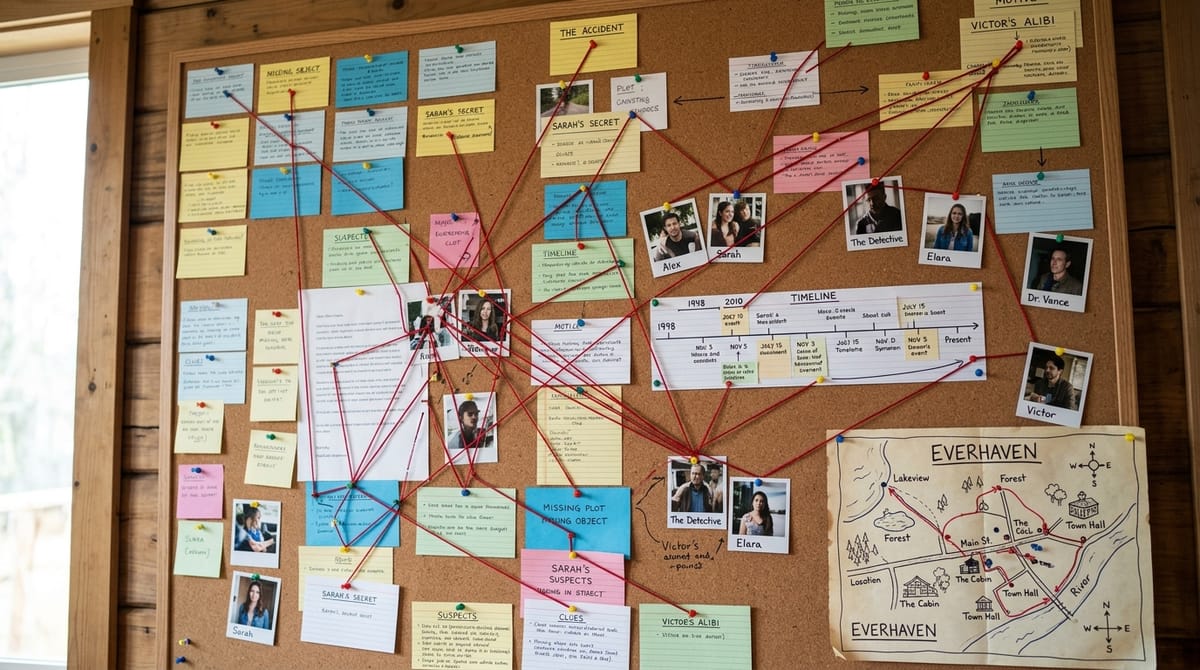
You've heard the advice a thousand times: outline your novel before you write it. So you dutifully create a numbered list of chapters and scenes. And it's… fine. You know what happens. But you can't see your story.
A linear outline tells you the sequence of events. But novels aren't just sequences. They're webs of relationships, parallel timelines, emotional arcs, and spatial worlds. To understand your story's shape — and to catch structural problems before you've written 80,000 words — you need to see it visually.
Here are five visual planning techniques that professional authors and screenwriters use, and how each one reveals something different about your story.
1. The Corkboard
What it is: A virtual (or physical) board where each scene is a card you can move, group, and annotate. Think of it as a wall of index cards — the classic Hollywood planning tool.
What it reveals: The flow and balance of your story.
The corkboard's power is spatial freedom. Unlike a linear outline, you can:
- Group scenes by chapter, act, subplot, or character
- Color-code cards by POV character, storyline, or mood
- Spot gaps — a cluster of action scenes with no breathing room, or a character who disappears for 10 chapters
- Rearrange freely — drag a scene from chapter 8 to chapter 5 and instantly see how it changes the flow
Best for: Pantsers who need some structure without a rigid outline. Writers working with multiple POVs or subplots. Anyone who thinks better with visual arrangement than with lists.
Pro tip: Keep each card to one sentence describing the scene's purpose: "Marcus discovers the letter" — not a paragraph of detail. The corkboard is for the birds-eye view.
2. The Timeline
What it is: A horizontal chronological view of your story's events, showing when things happen relative to each other.
What it reveals: Pacing, parallelism, and temporal logic.
Timelines are essential when your novel has:
- Multiple timelines or flashbacks — where the narrative order differs from chronological order
- Parallel storylines — characters in different locations whose stories converge
- Time-sensitive plots — thrillers, mysteries, or any story where "when" matters as much as "what"
A timeline view lets you:
- Verify that your chronology is physically possible (can your character really get from London to Edinburgh in the time between chapters?)
- Balance pacing — long stretches of story-time compressed into one chapter, vs. moments expanded across many
- Spot parallelism opportunities — what are different characters doing at the same moment?
Best for: Stories with complex chronologies, dual timelines, ensemble casts, or time-sensitive plotting. Historical fiction writers managing real events alongside fictional ones.
Pro tip: Use two rows — one for narrative order (the order the reader experiences events) and one for chronological order (when events actually happen). The gaps between them are where dramatic tension lives.
3. The Matrix (Scene Grid)
What it is: A grid or table where rows are scenes and columns are attributes — POV character, location, subplot, status (draft/revised/final), or any other category you choose.
What it reveals: Patterns, distribution, and gaps.
The matrix answers questions that are invisible in a linear outline:
- Which character has the most POV scenes? Is the distribution intentional?
- Are all my scenes set in the same three locations? Should I vary more?
- Which subplots haven't been touched in the last 10 scenes?
- How many scenes are still in rough draft vs. revised?
Think of it as a spreadsheet view of your novel — but one designed for creative analysis, not accounting.
Best for: Writers managing multiple POV characters, complex subplot weaving, or tracking revision progress. Series writers juggling dozens of recurring elements.
Pro tip: Sort and filter the grid by different columns to see different patterns. Sort by character to see each character's journey in isolation. Sort by location to see how settings cycle. Sort by status to see what still needs work.
4. The Arc Tracker
What it is: A visual chart that plots emotional or narrative intensity across your story's scenes or chapters — typically as a line graph or curve.
What it reveals: Emotional rhythm and pacing.
Every novel has an emotional shape. A thriller should look like a saw blade — rising tension, brief release, rising higher. A literary novel might have a slower build to a devastating climax. A romance follows predictable beats of attraction, conflict, and resolution.
The arc tracker lets you:
- Plot emotional intensity per scene and see the overall shape of your story
- Track individual character arcs — where does each character hit their low point? Their breakthrough?
- Identify flat spots — long stretches where nothing escalates or changes
- Verify genre beats — does your midpoint fall where it should? Is your climax actually the highest point?
Some tools can even use AI to analyze your manuscript and automatically map emotional arcs, giving you an objective view of your story's rhythm.
Best for: Writers who care deeply about pacing and emotional resonance. Genre writers hitting specific structural beats. Any writer in revision who senses "something is off" but can't pinpoint what.
Pro tip: Track at least two arcs — the external plot (events) and the internal arc (character growth). The interplay between them is where great stories live.
5. The Relationship Web
What it is: A network graph where characters are nodes and their relationships are connecting lines (edges), often color-coded by type — love, rivalry, mentorship, family, etc.
What it reveals: Social dynamics, isolation, and missed connections.
A relationship web makes character dynamics visible at a glance:
- Central characters have many connections; peripheral characters have few. Is that intentional?
- Isolated characters appear as disconnected nodes. If your villain never interacts with your secondary lead, is that a gap or a choice?
- Clusters reveal social groups — and the bridges between them are often your most interesting characters
- Changing relationships across the story show character growth — enemies becoming allies, friends becoming rivals
For ensemble casts or multi-POV novels, a relationship web is indispensable. It prevents the common problem of characters who should interact but never share a scene.
Best for: Ensemble cast novels, romance (especially multi-couple stories), epic fantasy with complex political dynamics, mysteries where everyone is connected. Series writers tracking relationships that evolve across books.
Pro tip: Create two versions — one for the start of the story and one for the end. The differences tell the story of your novel's social transformation.
Bonus: The World Map
If you're writing speculative fiction, historical fiction, or any story where geography matters, a world map with annotated locations transforms abstract settings into a navigable world.
Drop pins on locations, note which scenes take place where, and suddenly your story has spatial logic. Characters can't teleport between distant cities in a single scene transition (unless your world allows that, in which case — note it in your story bible).
Why Visual Beats Linear
Every visual technique above reveals something that a linear outline can't:
| Technique | What It Reveals |
|---|---|
| Corkboard | Flow, balance, and grouping |
| Timeline | Pacing, chronology, and parallelism |
| Matrix | Patterns, distribution, and gaps |
| Arc Tracker | Emotional rhythm and structural beats |
| Relationship Web | Character dynamics and social structure |
The best novelists use multiple views, switching between them as needed. Outline mode for plotting. Corkboard mode for rearranging. Timeline mode for chronology checks. Arc tracker for pacing. Relationship web for character dynamics.
Your story is multidimensional. Your planning tools should be, too.
ProseWeave's Canvas 2.0 gives you all six visual views — corkboard, timeline, matrix, arc tracker, world map, and relationship web — integrated with your Story Bible and AI-powered analysis. Explore Canvas 2.0 →